HEALTH & CARE.
Feeding
Your puppy is being fed a blend of Royal Canin Small Breed Puppy Food . I always leave a bowl of puppy food available at all times along with fresh water. I recommend if you wish to feed at meals times, you take the portion of daily requirement and divide into 3 meals. Toy dogs do not usually over binge and I find they can be free fed. If you wish to change from these brands of dog food, it is recommended that you change your food slowly by adding small amounts of the new food at each meal until you have decreased the old food to nothing. Your puppy should be fed puppy food until they are one year old.
Care


Contrary to popular opinion, the Hairless does not need to wear sun block, moisturizing lotion, or any other substance applied to the skin at any time; often that just causes problems. The skin has a better chance of staying healthy if nothing is put on it. Cresteds do need to be bathed regularly, however, every one or two weeks.
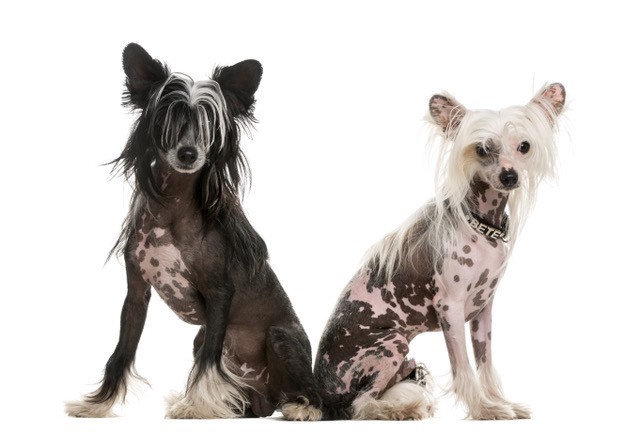
Many of the Hairless types actually have a lot of body hair. Unsurprisingly, most people aren’t prepared for how hairy a Hairless can be, and it can be an issue for allergy sufferers. These dogs aren’t hypoallergenic; they’re just low shedders compared to other breeds — but still, they shed more than you’d think a “hairless” dog would. And even the Hairless has noticeable hair on his head, legs, and tail. Some allergic people are fine with the Hairless variety, while others have no tolerance.
This body hair must be kept shaved to keep the skin healthy. Letting it grow out is often excused as a way to keep the dog warm, but the long coat doesn’t perform this function and instead triggers skin problems (sweaters are a better option for warmth). The Crested doesn’t sweat through his skin, and he has the same body temperature as any other breed. Some are prone to a canine equivalent of acne, however.
The Hairless Crested is incredibly, unbelievably tolerant of heat. He can lie in 100-degree sun for hours, like a lounge lizard, with no problems. He rarely pants and drinks very little water, which is pretty disconcerting for experienced dog owners who leave lots of water out.
Conversely, he has absolutely no tolerance for cold. Some people try to “harden” their Crested by exposing him to cold, as though he were a seedling. This is not only cruel, it doesn’t work. Cold will kill this dog a lot faster than heat will.
Take a cautious approach to vaccinations, cortisone drugs, and topical applications with this dog. Rabies shots often trigger reactions. Some Cresteds can have a terrible reaction to medications, including topical flea preventives. A conservative approach to drug therapy is safest, so don’t use anything that is not actually necessary. Normally, they don’t need any flea or tick preventives — they are a last resort for fleas.
Cresteds are wonderful family dogs who love to be with the people in their lives. They do well with children, although you should consider the age of the children and how they interact with dogs before bringing this small creature into your heart and home. They can be hurt easily and shouldn’t be left unsupervised with children, or even alone out in the yard. With family members of any age who know how to handle dogs, however, they’ll play games, affectionately cuddle up on the couch, and enjoy an active life.
Because they’re so social and needy, Cresteds can suffer from separation anxiety, which can lead to barking and destructive habits. They’ll climb and dig to escape confinement if left on their own for too long. When you’re around, they’re comparatively quiet dogs, but they will alarm bark.
They do well in apartments and any other type of dwelling. The Chinese Crested is a wonderful family dog who is playful, affectionate, and endearing. He’s a stable companion who fills his owners’ lives with love, laughter, and entertainment.
Chinese Cresteds are adept at jumping, digging, and climbing. Don’t make the common mistake of underestimating their athletic abilities just because they’re small. They are Houdini Hounds who can escape from virtually any enclosure. A six-foot fence around the yard is a good idea; if they can get a grip on a fence, they’re over it. They have absolutely no fear of climbing or jumping, and they can clear four feet from a standing position.
Once they’re out, they move fast and are — how shall we say this — averse to recapture. They are more stubborn than you are. Their athletic abilities are why many Chinese Cresteds are taking the conformation, obedience, and agility worlds by storm.
Chinese traders once used the Chinese Crested as ratters on their ships, and they may have served this function in agricultural settings as well. Today they enjoy life as beloved family pets, but they also have the personality to excel at being more than just pampered pooches.
Health

As with any breed there are several conditions to watch for in a Chinese Crested:
- Progressive retinal atrophy
- Allergies
- Poor dentition
- Canine multiple system degeneration
- Luxating patella
- Our dogs are DNA tested for Progressive retinal atrophy (PRA) and for Luxating Patella (PLL)
Progressive Retinal Atrophy
Common Symptoms
Progressive retinal Atrophy, progressive Rod-cone degeneration (PRA-prcd) is a late onset, inherited eye disease affecting Chinese Cresteds. PRA-prcd occurs as a result of degeneration of both rod and cone type Photoreceptor Cells of the Retina, which are important for vision in dim and bright light, respectively. Evidence of retinal disease in affected dogs can first be seen on an Electroretinogram around 1.5 years of age for most breeds, but most affected dogs will not show signs of vision loss until 3 to 5 years of age or later. The rod type cells are affected first and affected dogs will initially have vision deficits in dim light (night blindness) and loss of peripheral vision. Over time affected dogs continue to lose night vision and begin to show visual deficits in bright light. Other signs of progressive retinal atrophy involve changes in reflectivity and appearance of a structure behind the retina called the Tapetum that can be observed on a veterinary eye exam. Although there is individual and breed variation in the age of onset and the rate of disease progression, the disease eventually progresses to complete blindness in most dogs. Other inherited disorders of the eye can appear similar to PRA-prcd. Genetic testing may help clarify if a dog is affected with PRA-prcd or another inherited condition of the eye.
Breed-Specific Information for the Chinese Crested
The Mutation of the PRCD gene associated with progressive retinal Atrophy, progressive Rod-cone degeneration has been identified in the Chinese Crested. Though the exact frequency in the overall Chinese Crested population is unknown, 3% out of 99 Chinese Crested dogs .
We Dna test our dogs for PRA-prcd
Luxating patella
The “patella” is the kneecap for both people and pets. It’s attached to the shinbone at one end and to powerful thigh muscles at the other end. It sits at the front of the stifle joint, which is the knee joint in dogs and cats. When the knee functions normally, the patella rides smoothly along a groove in the femur. This groove is there to keep the patella where it belongs, which will allow for increased joint flexibility and provide leverage to the knee.
A luxating patella generally occurs when the groove of the femur is too shallow, causing the patella to slide out of place and move too far to one side or the other. This can lead to a weakening of the ligaments which hold the patella in place.
The condition is more common in toy dogs, but it could affect cats or larger dogs as well. Occasionally it’s caused by trauma but most of the time it’s a genetic birth defect known as “polygenic trait.”
Symptoms
Luxating patella generally presents between four and six months of age. Its appearance could be relatively subtle. You might notice a skip in your pets step, or he might hold one paw in the air and not let it touch the ground.
It might appear, from the way he runs, that only one leg is affected but often both knees will suffer from the same condition.
A luxating patella can be felt from the outside and you’ll be able to actually move the kneecap out of place. For this reason it’s possible your groomer will notice it before you do.
Large dogs who suffer from luxating patella tend to have other conditions as well. Likely, they’ll have poor skeletal alignment and stand knock-kneed.
Your pet won’t necessarily exhibit any pain, even when he limps. It simply depends on the grade of the condition.
Our dogs are DNA tested for Luxating patella